

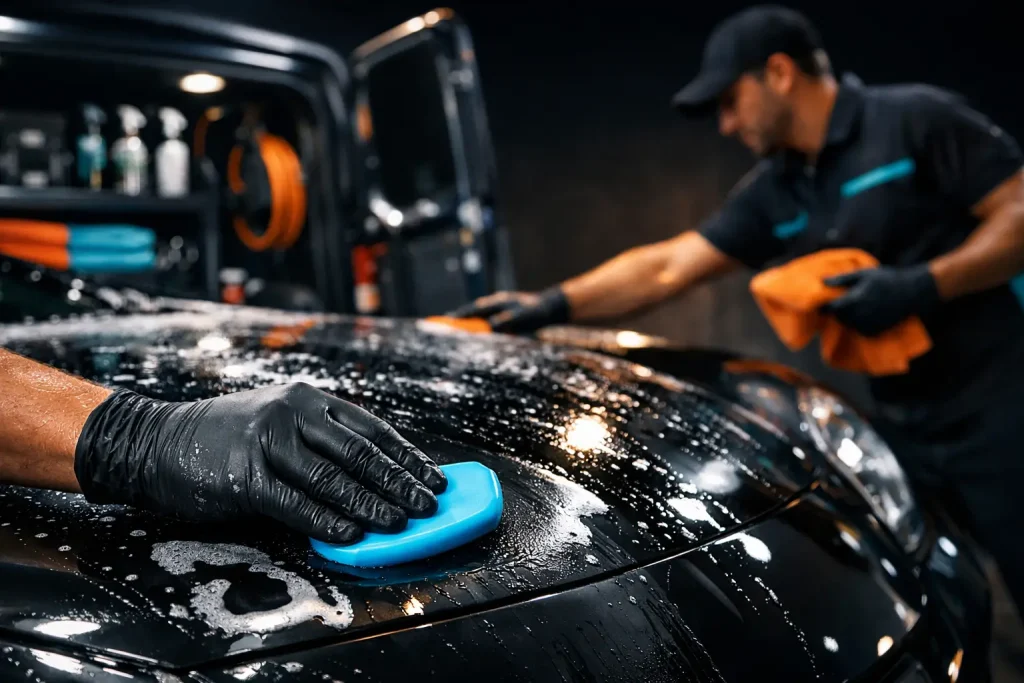
Run your hand lightly over freshly washed paint and it may still feel rough. That gritty texture is exactly why a clay bar treatment for cars exists. Washing removes loose dirt, but it does not always lift bonded contamination like brake dust, road film, tree sap mist, industrial fallout, and stubborn residue that sticks to the surface.
If your paint looks clean but feels dull, drags under your fingertips, or loses shine faster than it should, claying is often the missing step. It is one of the fastest ways to restore that smooth, glassy finish that makes waxes, sealants, and ceramic protection perform better.
What a clay bar treatment for cars actually does
A clay bar treatment works by pulling embedded contaminants off the clear coat, glass, and sometimes wheels. These particles sit above the paint surface and can remain even after a proper hand wash. That contamination blocks gloss, makes paint feel rough, and can interfere with polishing or protection.
Think of it as surface decontamination, not paint correction. A clay bar does not remove scratches, swirl marks, or oxidation on its own. What it does is create a cleaner foundation so the paint can reflect light better and so protective products bond more evenly.
That difference matters. When the surface is properly decontaminated, wax spreads more smoothly, sealants last more consistently, and ceramic coatings have a better chance of bonding the way they should. Even without polishing, many vehicles look noticeably sharper after claying simply because the paint is cleaner at a microscopic level.
Signs your car needs a clay bar treatment
You do not need to guess. After washing and drying the vehicle, gently run your fingertips across the hood or upper door panels. If the paint feels rough instead of slick, bonded contamination is likely present.
You may also notice tiny specks on light-colored paint, reduced gloss that washing does not fix, or water behavior that seems uneven across the surface. Vehicles that spend time outdoors, near construction, under trees, or in high-traffic urban areas usually pick up contamination faster.
In places with heat, dust, and frequent road exposure, buildup can happen sooner than many owners expect. That is why a clay bar treatment for cars often makes sense as part of periodic detailing, not just as a one-time rescue service.
What gets removed and what does not
Clay is effective against rail dust, industrial fallout, overspray, road grime residue, bug residue that has bonded to the surface, and light tree sap mist. It can also lift contamination from glass, which is why windows often feel smoother and look clearer after the process.
What it does not do is remove deep etching, stone chips, heavy water spot damage, or paint defects below the surface. If the finish is scratched or oxidized, polishing may still be needed after claying. That is where professional assessment matters, because not every dull-looking car needs the same level of correction.
There is also a trade-off. Claying is highly effective, but aggressive clay or poor technique can leave light marring on softer paint. That does not mean clay is risky by default. It means the process needs the right grade of clay, plenty of lubrication, and a careful hand.
How the process should be done
A proper clay treatment starts with a thorough wash. There is no shortcut here. If loose dirt remains on the surface, rubbing clay across it can drag debris and increase the chance of marring.
Once the car is clean, a lubricant is sprayed onto a small section of paint. The clay is then moved gently across the lubricated surface in straight, controlled passes. You are not scrubbing. You are letting the clay glide and pick up contamination from the top layer.
As the clay collects debris, it is folded to expose a clean section. This continues panel by panel until the paint feels smooth. Afterward, the vehicle is wiped down and usually protected with wax, sealant, or coating.
The key is pressure. More pressure does not mean better results. In fact, it usually means more marring and less control. Professional detailers focus on technique, lubrication, and product choice because every paint system responds a little differently.
Clay bar vs. polishing
These two services are often confused, but they solve different problems. Clay removes bonded contamination sitting on the surface. Polishing removes a tiny amount of clear coat to reduce swirls, haze, and minor defects.
If your paint feels rough, clay is the answer. If your paint feels smooth but still looks swirled or cloudy in direct light, polishing is likely the better next step. In many premium detailing services, claying comes before polishing because it clears the surface and prevents contaminants from interfering with the polishing stage.
For owners who want visible improvement without a full paint correction, clay plus wax can be a smart middle ground. It improves smoothness and gloss at a lower level of intensity, time, and cost than machine polishing.
Is a clay bar treatment safe for every car?
Generally, yes, when it is done correctly. Most painted vehicles benefit from periodic claying, especially if they are exposed to daily commuting, outdoor parking, or harsh environmental conditions. It can also be used on glass and certain smooth exterior surfaces.
But it is not a one-size-fits-all process. Older paint, delicate finishes, heavily neglected surfaces, and vehicles with soft clear coats may require extra care. Some contamination is so severe that chemical decontamination should be used first to reduce friction during the clay stage.
This is one reason professional service has real value. The surface condition determines the method, not the other way around. A quality-first team will not use the same clay grade and process on every vehicle just to move faster.
How often should you do it?
For most daily-driven vehicles, two to four times a year is enough. The exact schedule depends on how the car is used, where it is parked, and what kind of protection it already has.
A car that is garage-kept and regularly maintained may only need claying a couple of times a year. A vehicle parked outdoors in a busy city environment may need it more often. If you are noticing rough paint between protection services, that is usually a better signal than the calendar.
Too much claying is unnecessary. Since the goal is targeted decontamination, it should be done when the paint needs it, not every time the car is washed. Good maintenance washes help extend the time between treatments.
Why protection should follow immediately
After claying, the surface is cleaner and more exposed. That makes it the ideal time to apply protection. Whether that is wax, paint sealant, or ceramic coating depends on the result you want and how long you want it to last.
Wax can add warmth and gloss. Sealants generally offer longer durability. Ceramic coatings deliver stronger long-term protection and easier maintenance, but they depend heavily on preparation. If the surface is not properly decontaminated first, even premium protection will not perform at its best.
This is why clay treatment is often bundled with waxing or prep work before coatings. The shine is part of the appeal, but the real value is in what comes next – better bonding, smoother maintenance, and a finish that stays cleaner for longer.
When mobile clay bar service makes the most sense
For busy owners, the hardest part of car care is not interest. It is time. A clay treatment is detail-oriented work, and doing it correctly takes patience, clean tools, proper lubrication, and the right follow-up protection.
That is where premium mobile service stands out. Instead of setting aside half a day and hoping for the right result, you get trained hands, controlled products, and professional execution at your doorstep. For families with multiple vehicles or professionals who would rather not spend a weekend on paint decontamination, convenience is not a bonus. It is the reason the service gets done at all.
At Ride Revivers, that mindset shapes the service itself – not just making a car look cleaner, but restoring smoothness, gloss, and protection without disrupting your schedule.
A great finish is not only about shine under perfect lighting. It is about how the paint feels when you touch it, how easily it stays clean afterward, and how well it holds its protection over time. When your vehicle has lost that smooth, premium feel, clay treatment is often the reset it needs.