

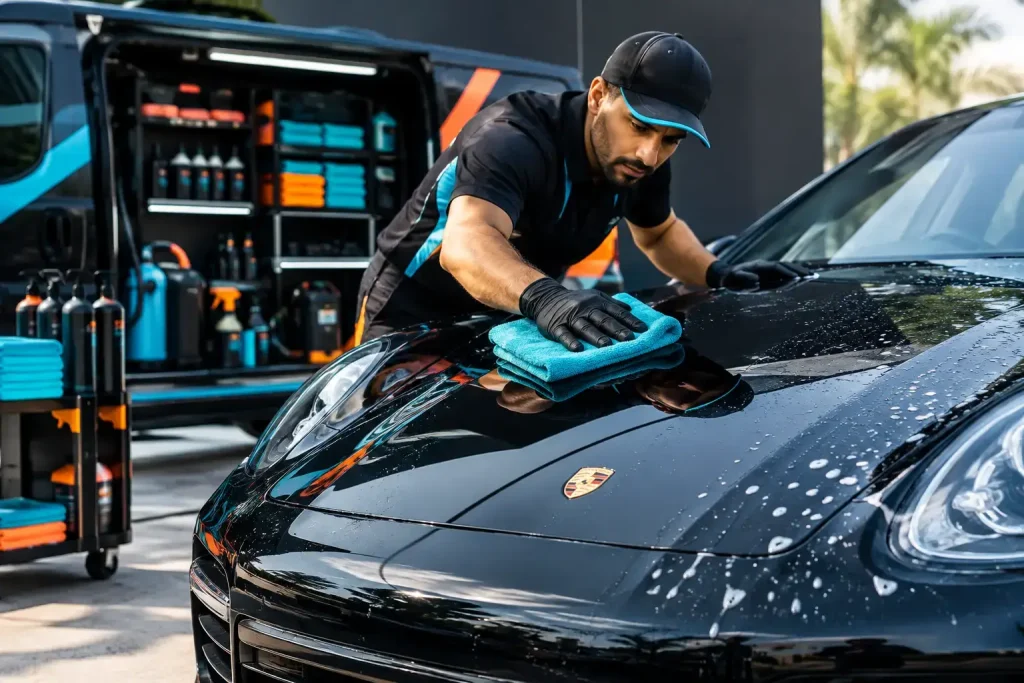
Run your hand lightly across a freshly washed hood. If it feels gritty, rough, or uneven, the paint is not truly clean – even when the vehicle looks polished from a few steps away. This guide to car paint decontamination explains what creates that rough feeling, how professional removal works, and when your car needs more than a routine wash.
A standard wash removes loose dust, surface dirt, and everyday road film. Paint decontamination addresses the particles that have bonded to the clear coat: brake dust, industrial fallout, tree sap, tar, hard-water minerals, and airborne grime. Left in place, these contaminants can dull gloss, stain the finish, and make waxes or protective coatings perform poorly.
What Paint Decontamination Actually Does
Your vehicle’s clear coat is smooth on a microscopic level, but it is constantly exposed to contaminants that settle into its surface. In busy urban driving, tiny iron particles from brakes and roads are especially common. They may be invisible at first, but they can oxidize and create small orange specks or leave the paint feeling coarse.
Decontamination removes this bonded material without treating the paint like a scrubbing project. The goal is a clean, smooth surface that reflects light evenly and is ready for polishing, waxing, or ceramic protection. It is the difference between a vehicle that has been washed and one that has been properly prepared for a premium finish.
This process does not repair deep scratches, stone chips, or clear-coat failure. It can, however, reveal the true condition of the paint and make later correction work more effective. If swirls or oxidation remain after decontamination, polishing may be the next step.
Signs Your Car Needs Paint Decontamination
The simplest test is touch. After washing and drying the vehicle, glide clean fingertips over the paint inside a thin plastic bag. The bag amplifies surface texture, making bonded contamination easy to feel.
You may also notice reduced gloss, water that clings unevenly, dark dots around the lower doors, or tiny orange spots near the wheels and rear of the vehicle. Sap and tar often appear as sticky bumps, while water spotting can leave chalky rings that do not disappear with a normal wash.
In Dubai, frequent dust exposure, high temperatures, construction fallout, and daily traffic can make contamination build up faster than many owners expect. Cars parked outdoors or driven regularly through high-traffic areas may benefit from professional decontamination several times a year. The right schedule depends on where the vehicle is parked, how often it is driven, and whether it already has a quality protective layer.
The Professional Paint Decontamination Process
Proper decontamination is controlled and methodical. Skipping steps or using the wrong product can create scratches, haze, or unnecessary stress on the finish.
Start with a safe exterior wash
The vehicle must be washed before any bonded-contaminant treatment begins. This removes loose grit that could drag across the paint during later steps. Wheels, wheel arches, lower panels, badges, and panel gaps deserve special attention because they collect the heaviest grime.
A clean wash process also makes it easier to identify what is actually bonded to the paint. Sometimes what looks like staining is simply road film. Other times, a clean panel reveals iron deposits, tar spots, or mineral marks that need targeted treatment.
Use chemical decontamination first
Chemical decontamination is often the safest first response because it dissolves or loosens specific contaminants rather than relying immediately on friction. An iron remover reacts with embedded ferrous particles, while a dedicated tar remover breaks down road tar, adhesive residue, and similar petroleum-based marks.
These products should be used according to their instructions, on cool panels and away from direct sun when possible. They are not household cleaners, and stronger is not always better. Letting a product dry on the paint, applying it to a hot panel, or using it carelessly around sensitive finishes can create avoidable problems.
Follow with mechanical decontamination when needed
After chemical treatment, a clay bar or synthetic clay mitt can remove the remaining bonded particles. Used with plenty of lubrication, it glides across the paint and lifts contamination that washing and chemicals did not remove.
This step requires judgment. Clay is effective, but it can lightly mar soft paint if it is aggressive, dry, dirty, or used with too much pressure. Fine-grade clay and clean lubricant are usually the right choice for well-maintained vehicles. Heavier contamination may need a more intensive approach, followed by polishing to restore maximum clarity.
Inspect before applying protection
Once the surface is clean and smooth, the paint should be assessed under proper lighting. This is when swirl marks, water-spot etching, and fine scratches become more visible. Some owners choose to protect the finish immediately; others add a polishing stage first to improve depth and reflection.
Wax, sealant, and ceramic coatings all benefit from a contamination-free surface. Protection does not bond properly over tar, iron particles, or rough residue. Preparing the paint correctly helps the treatment last longer and keeps maintenance washes easier afterward.
Clay Bar, Iron Remover, or Both?
There is no single product that solves every contamination issue. Iron remover is best for embedded metal fallout, especially around wheels, lower panels, and rear sections. Tar remover is designed for sticky black spots and road residue. Clay handles the fine, stubborn particles that remain after chemical treatment.
For a lightly contaminated, regularly maintained vehicle, a thorough wash and chemical decontamination may be enough. For paint that feels rough across multiple panels, clay is usually the finishing step. A heavily neglected vehicle may require all three methods, plus polishing afterward.
The trade-off is time and paint sensitivity. More aggressive mechanical decontamination may produce a cleaner surface, but it also increases the chance of minor marring. That is why a professional service should start with the least aggressive method that can deliver the result.
Common Mistakes That Take Away From the Finish
Paint decontamination is not difficult in principle, but it is easy to rush. The most common errors are using clay on a dirty vehicle, working on hot paint, reusing a dropped clay bar, allowing chemicals to dry, and applying protection before the surface is fully clean.
A dropped clay bar should be discarded. It can pick up grit from the ground, and that grit can scratch paint in seconds. Similarly, a dry clay bar should never be forced across a panel. Lubrication is what allows it to move safely.
Another mistake is assuming every rough or dull area needs stronger chemicals. Mineral deposits and etched water spots can require a different correction process. If the mark remains after safe decontamination, it may be in the clear coat rather than sitting on top of it. Polishing, not more scrubbing, is often the better answer.
How Often Should You Decontaminate Your Paint?
For most vehicles, a professional paint decontamination service every six to twelve months is a sensible baseline. Vehicles exposed to outdoor parking, construction dust, coastal air, brake-heavy commuting, or frequent long drives may need attention closer to every three to six months.
The best indicator is not the calendar alone. It is how the paint feels, how easily it cleans, and how well water behaves on the surface. If your once-slick paint has become rough or your protection no longer beads water evenly, contamination may be the reason.
Routine premium washes help slow the buildup, but they are not a replacement for periodic deeper treatment. Regular maintenance removes the contaminants before they bake on, while decontamination resets the surface when ordinary washing can no longer deliver that smooth, revived finish.
When Professional Care Makes Sense
A DIY approach can work for enthusiasts with the right products, shade, time, and confidence. But professional care is often the better choice when the vehicle has visible fallout, stubborn tar, water-spot concerns, delicate paint, or a ceramic coating that needs careful maintenance.
Ride Revivers brings trained vehicle care directly to your doorstep, making it easier to pair a thorough exterior clean with clay treatment, polish, and lasting protection without giving up part of your day. The value is not simply in a cleaner car. It is in using the right method at the right stage, so the finish looks sharper and stays easier to maintain.
A smooth paint surface changes the way your vehicle reflects light, sheds grime, and carries its protection. Give the finish the same level of care you expect from the rest of your vehicle, and the shine will speak for itself.